

Pain in the leg can start in the lower back. A irritated nerve root or a stiff, overloaded spinal joint can send pain into the buttock, thigh, calf or foot, even when the leg itself is perfectly healthy. Most episodes settle with time and sensible movement. A few need urgent medical attention, and those are listed below so you can check them first. If the pain is lingering, keeps returning or is stopping you doing normal things, a hands-on assessment of the spine can find where it is coming from.
TL;DR
- Back-related leg pain comes in two broad forms: nerve-root pain (sciatica), which is sharp, burning and travels below the knee, and referred pain, which is dull, deep and hard to pinpoint.
- Most cases improve within weeks, and the official advice is to keep moving rather than rest completely.
- Numbness around the genitals or bottom, bladder or bowel changes, or pain and weakness in both legs mean 999 or A&E, not waiting for an appointment.
- Scans are usually not needed at first, because most spinal changes show up in people with no pain at all.
- If pain is not improving after a few weeks or keeps coming back, a proper examination can identify the cause and set out a plan.
Table of Contents
- What leg pain from the back actually feels like
- What can cause pain to travel from the back into the leg
- Symptoms that point to the back
- Warning signs: when to get urgent help
- What you can do at home
- Do you need a scan?
- When to book an assessment
- Our perspective on leg pain that starts in the back
- Book an assessment at Elaris
- FAQ
- Sources
What leg pain from the back actually feels like
The spine and the leg share the same wiring. The nerves that supply your buttock, thigh, calf and foot leave the spine in the lower back. When something at that level is irritated, the brain can read the signal as coming from the leg.
There are two patterns worth telling apart, because they point to different causes and different timelines.
Nerve-root pain: sciatica
NICE describes sciatica as radiating leg pain caused by compression or irritation of the lumbosacral nerve roots that form the sciatic nerve. It is felt in the back or buttock and travels down the leg below the knee into the foot and toes. It may come with tingling, numbness or weakness in that leg.
People often describe it as burning, shooting or electric, sometimes with a heavy or tight feeling in the leg. It is usually on one side only.
Referred pain: the dull, deep ache
NHS guidance from Scotland describes non-specific radiating leg pain as pain referred into the leg from the lumbar spine without nerve-root irritation or compression. It tends to be dull, aching, gnawing or pressure-like, covers a wide area and is hard to localise. It sits deep in the buttock or thigh, occasionally the lower leg, and rarely reaches the foot.
| Nerve-root pain (sciatica) | Referred pain from the spine | |
|---|---|---|
| Quality | Sharp, burning, shooting | Dull, aching, gnawing, pressure |
| Where | Down the leg, often below the knee, into foot or toes | Buttock and thigh, rarely the foot |
| Area | Follows a line down the leg | Wide, hard to point to |
| Other signs | Tingling, numbness, weakness possible | Usually none |
| Usually one-sided | Yes | Not always |
The two can overlap, and you can have both at once. That is one reason a hands-on examination is more reliable than guessing from a description.
What can cause pain to travel from the back into the leg
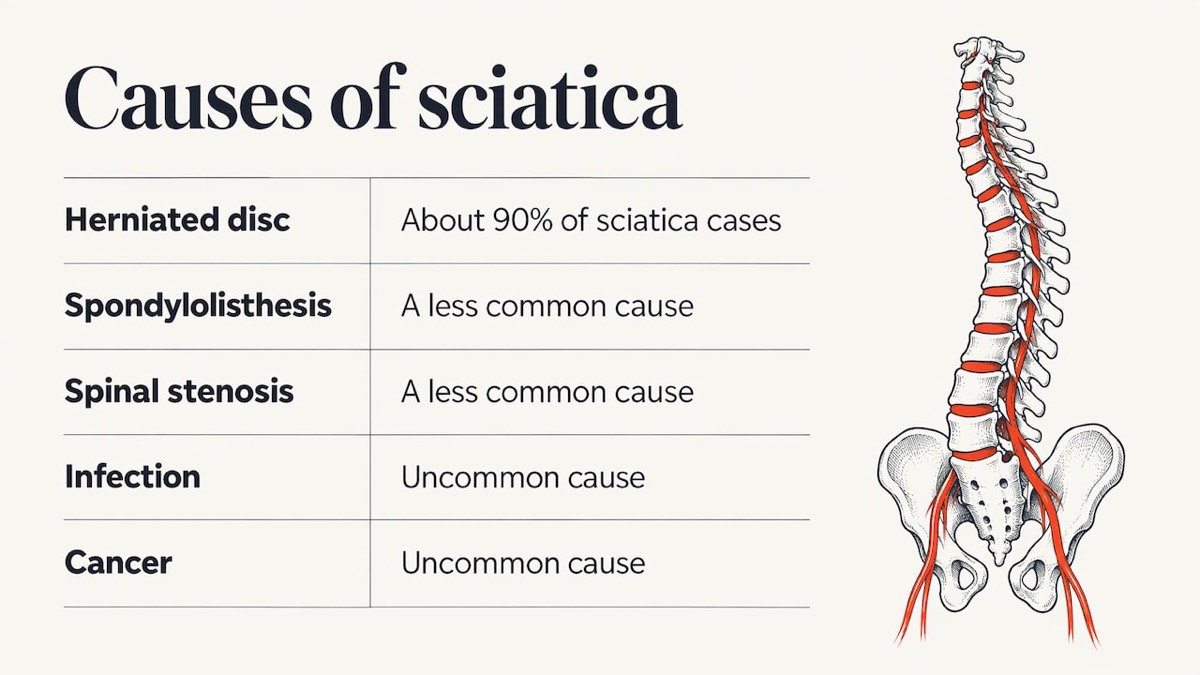
NICE states that the nerve-root compression behind sciatica may be caused by a herniated disc, in about 90% of cases and most commonly through degenerative change. Less often the cause is spondylolisthesis (a vertebra slipping forward), spinal stenosis (narrowing of the canal), infection or cancer. The last two are uncommon, which is why the red flags later in this article matter.
When the pain is referred rather than nerve-driven, the list is wider. The Scottish guidance names lumbar radiculopathy, hip osteoarthritis, greater trochanteric pain syndrome and other musculoskeletal problems, plus causes outside the musculoskeletal system, as possibilities. That is why a pain in the side of the hip or thigh is not automatically a spine problem, and why the examination needs to check the hip and the back together.
Who is more likely to get it
NICE lists the modifiable risk factors for a first episode of sciatica: smoking, overweight, physical inactivity, and demanding work such as whole-body vibration or strenuous physical effort. Older age and genetics also play a part. Most of the modifiable factors can be changed gradually, and none of them is a reason to feel at fault.
Symptoms that point to the back
NICE says these features should lead you and your clinician to suspect sciatica:
- pain on one side, running below the knee to the foot or toes
- a burning quality, with a heavy or tight feeling
- pain made worse by bending forward, twisting or coughing
- low back pain, if present, that is milder than the leg pain
- numbness or tingling in the area served by one nerve root
- weakness or changed reflexes in the leg
- pain reproduced by a straight leg raise test
That last point is a useful one. In a straight leg raise, the examiner lifts your straight leg while you lie down. NICE describes the test as positive when pain is reproduced below 60 degrees of hip flexion. The same guidance notes that pain on bending forward that travels into the leg suggests a disc pressing on a nerve root, while pain on leaning backwards can suggest facet joint problems or spinal stenosis. So the direction that brings your pain on is a clue in itself.
If you want a deeper look at nerve-root symptoms, our article on lumbar radiculopathy symptoms and when to seek emergency care goes through them in detail.
Warning signs: when to get urgent help
Most back-related leg pain is not dangerous. A small number of cases involve pressure on the nerves at the base of the spine, called cauda equina syndrome. Read this list before anything else.
Call 999 or go to A&E if back pain comes with any of the following, according to the NHS:
- pain, tingling, weakness or numbness in both legs
- loss of feeling around the genitals or anus
- bladder or bowel changes, such as difficulty peeing or losing control
- changes in sexual sensation
- chest pain
- pain that started after a serious accident
King’s College Hospital explains that cauda equina syndrome is rare, at 1 to 3 in 100,000 people, but can lead to permanent leg paralysis and loss of bowel, bladder and sexual function if not assessed and treated urgently. Its warning signs include numbness or pins and needles between the inner thighs or genitals, numbness around the back passage, increasing difficulty passing urine or controlling its flow, and not knowing when your bladder is full or empty. Do not wait for a routine appointment with any of these.
Get an urgent GP appointment or call 111 if back pain is severe and starts suddenly, is getting worse quickly, or comes with feeling hot, cold, shivery or generally unwell, as the NHS advises.
If you are unsure which category you fall into, treat it as the more urgent one.
What you can do at home
The consistent message from NHS sources is to stay active. NICE advises people with sciatica to keep as active as possible, resume normal activities and work as soon as possible, adjust work where needed, and try simple exercises that may relieve symptoms.
Keep moving, little and often
Sussex Community NHS says gentle exercise within the limits of pain will not cause damage to tissues. Any increased discomfort should settle within 20 to 30 minutes of finishing, and people who avoid normal movement excessively are more likely to have pain for longer. Its separate leaflet suggests moving every 30 to 40 minutes rather than staying still, and pacing activity without pushing through pain.
In practice that means:
- Replace long stretches of sitting or lying with short walks.
- Break up desk work or driving with a minute of standing and moving.
- Do a little more each day rather than a lot on a good day and nothing on a bad one.
- Stop an exercise if it brings sharp pain or makes you feel unwell.
The NHS has exercise videos for sciatica. It advises speaking to a healthcare professional first if you have a health problem, an injury, or are pregnant or recently gave birth.
Pain relief and heat
The NHS suggests anti-inflammatory medicine such as ibuprofen if it is suitable for you. It says paracetamol on its own is not recommended for back pain, though it may be used alongside another painkiller. It also suggests an ice pack for pain and swelling and a heat pack for stiffness or muscle spasm, in its back pain guidance. Check with a pharmacist or your GP if you have asthma, stomach problems, kidney problems or take other medicines.
How long it takes
Most people improve. NICE says most people with sciatica improve with conservative care within a few weeks to a few months, though recurrence is common. A Cambridgeshire NHS leaflet gives 6 to 12 weeks as the usual course for sciatica, and Leicestershire Partnership NHS Trust says most new leg pain improves within 6 to 8 weeks.
So a slow start is normal. The point to watch is the trend: is it easing, stuck or getting worse?
Do you need a scan?
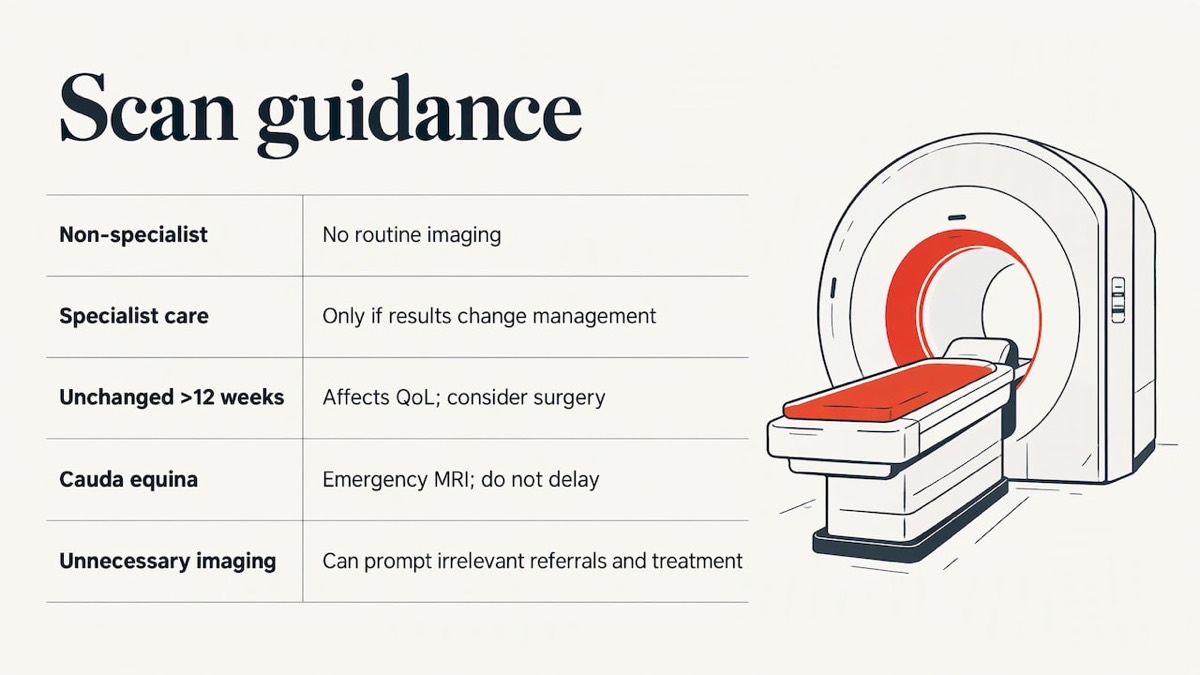
Usually not at the start, and that surprises many people. NICE guidance says imaging should not routinely be offered in a non-specialist setting for low back pain with or without sciatica. In specialist care it should be considered only if the result is likely to change management.
The reason is that scans show a lot of things that are not the cause. NHS Inform explains that structural changes in the spine are very common with age and often present in people who have no symptoms. It says a scan can be considered when symptoms are unchanged after more than 12 weeks, still greatly affect quality of life, and you want to consider surgery.
The Royal Colleges’ evidence body adds that unnecessary imaging can lead to further referrals and treatment for findings that are not clinically relevant. The exception is suspected cauda equina syndrome, where the same source says an MRI should be done as an emergency and not delayed.
If you want to know what each type of scan shows, we have explained it in X-ray vs MRI: which scan shows what.
What takes the place of a scan in a first assessment is a careful examination. NICE says assessment should include a history, a psychosocial assessment, a focused musculoskeletal and neurological examination, a check for red flags and consideration of other diagnoses.
Other things people try alongside
Many people also explore hands-on soft-tissue work for tight muscles around the hip and buttock. If that interests you, this page on massage for sciatica looks at what helps and when to book. Soft-tissue work sits alongside an assessment of the spine, and it does not replace working out where the pain is coming from.
When to book an assessment
Leicestershire Partnership NHS Trust lists the situations where further help makes sense: pain not improving after a few weeks, difficulty returning to work or normal activities, leg pain that keeps coming back, ongoing pain from the back into the leg, or wanting advice on exercise and recovery.
That list is a good rule of thumb whichever professional you see. If you recognise yourself in it, the next step is a proper examination, not another month of guessing. For some people the NHS is the right route, and we explain how referrals and cover work in chiropractic on the NHS.
Some back-related leg pain has a different story. Pain in pregnancy often involves the pelvis, so speak to your midwife, who can refer you to an NHS physiotherapist. Persistent morning stiffness in a younger person is a different pattern again, covered in ankylosing spondylitis symptoms.
Our perspective on leg pain that starts in the back
Over 25 years in practice, the most common mistake we see is treating the leg because that is where it hurts. The leg is often the messenger. If the cause sits in the lower back, hip or the way the two work together, working on the leg alone only brings brief relief.
That is why our assessment looks wider than the painful spot. With the Elaris Method™ we consider the structural picture, the neurological picture and the emotional factors that affect how pain is felt and how long it lingers. We use hands-on examination and neurological testing so that the plan is built from what we find in you, not from a label.
We also think people deserve time. You see the same two practitioners each visit, your treatment plan is written down and explained, and we measure progress at every stage, so you can see for yourself whether things are moving in the right direction.
And we never ignore the red flags. If anything you describe points to something that needs urgent medical attention, that comes first.
— Dr Stephen Davison (Doctor of Chiropractic)
Book an assessment at Elaris
If your leg pain is not easing, keeps returning or is getting in the way of work, sport or sleep, we can examine you and tell you what we find. Our sciatica and leg pain care and low back pain care are based at our clinic in Great Totham, and we see patients from Maldon, Tiptree and the surrounding villages.
Your first consultation and examination is £105. You can read how we work on The Elaris Approach page, or book your first consultation directly.
FAQ
Can a back problem cause pain only in the leg?
Yes. NICE notes that when sciatica is present, low back pain, if there at all, is less severe than the leg pain. So you can have a spinal cause and barely notice your back. This is one reason an examination of the spine is worth having when leg pain has no obvious local explanation.
Is walking good or bad for leg pain from the back?
For most people it helps. NHS sources advise keeping active, taking short walks and avoiding long periods of sitting or lying. Increased discomfort during gentle activity should settle within 20 to 30 minutes. If walking brings on sharp pain, weakness or numbness, stop and have it assessed.
How long does back-related leg pain last?
NHS sources give a range. Most new leg pain improves within 6 to 8 weeks, and sciatica commonly settles in 6 to 12 weeks, though it can last longer. If it is not improving after a few weeks, or keeps coming back, it is time to have it looked at.
Is leg pain from the back always sciatica?
No. Sciatica means nerve-root irritation, typically with pain below the knee. Pain referred from the spine is usually duller, deeper and in the buttock or thigh. Hip problems can also mimic both, which is why the hip and the back are examined together.
Sources
- Sciatica, NICE CKS
- Sciatica assessment, NICE CKS
- Spine related leg symptoms, Right Decisions
- Back pain, NHS
- Exercises for sciatica problems, NHS
- Low back pain and sciatica in over 16s, NICE NG59
- Sciatica, NHS inform
- Low back pain imaging, EBI
- Cauda equina syndrome, King’s College Hospital NHS
- Leg, Thigh or Calf, Leicestershire Partnership NHS Trust
- Sciatica management and self-help, Sussex Community NHS
- Sciatica leaflet, Sussex Community NHS
- Sciatica patient leaflet, Cambridge and District NHS
- Massage for sciatica