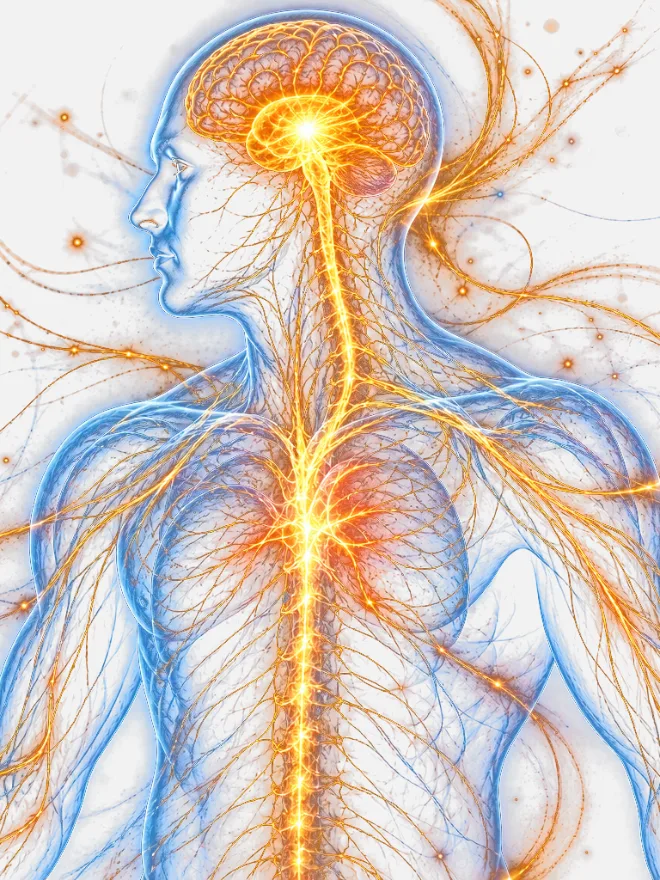
01 · The structure
The mechanistic world
Treats the body as a structure — joints, discs, muscles and alignment. It is precise, and it is where most chiropractic and physiotherapy begins and ends.
 ELARIS CHIROPRACTIC
The Elaris Approach
That is not a failure of effort. It may be a failure of explanation.
At Elaris we start from a different place. Not with your scan, or your diagnosis, or the list of things that have already been ruled out. We start with your nervous system — and with the understanding that persistent pain is rarely just a structural problem with a structural solution.
They are patterns. And patterns, with the right approach, can change.
Who this is for
If any of the following sounds familiar, you are in the right place.
Persistent back or neck pain that hasn't resolved despite treatment
Back, neck or joint pain that keeps coming back, or has lasted for months
Headaches arising from the neck, or tension and difficulty relaxing that sit alongside your pain
Aches and pains that move around and don't quite fit a single explanation
A feeling that something is being missed — that the structural explanation doesn't account for everything you are experiencing
The Three Worlds of Healing
Each sees part of the picture. Each, on its own, misses something.
01 · The structure
Treats the body as a structure — joints, discs, muscles and alignment. It is precise, and it is where most chiropractic and physiotherapy begins and ends.
02 · The conditions
Looks at the environment the body is being asked to function in — nutrition and diet, movement and exercise, sleep and recovery, lifestyle, physical surroundings, and the way a person cares for and relates to their body. It asks: what are we giving the body, and what conditions are we creating for health?
03 · The response
Concerns how a person perceives, processes and responds to their world. This is the psycho-neurophysiological dimension — the interaction between perception, emotional experience, the nervous system, physiology and the body's adaptive responses. It explores how experiences are interpreted through the nervous system, and how that processing may influence physiological state.
The ELARIS framework brings all three into a single clinical encounter: the structural precision of chiropractic, attention to the conditions that support health, and care that addresses how the nervous system is processing and responding to a person's world.
The Elaris approach
The Elaris framework is built on a simple but significant insight: the nervous system actively shapes your experience of pain — based not just on what is happening in your body right now, but on what it has learned to expect from a lifetime of accumulated experience.
That means the history you carry — the injuries, the stresses, the emotional experiences your nervous system encoded, often long before the current symptoms appeared — is clinically relevant. Not as background. As a primary part of the picture.
The result is a form of care most of our patients have not encountered before — not because it is alternative, but because it is genuinely different in its design.
We are trained to work across all three simultaneously — not as separate conversations, but as a single integrated clinical encounter.
01
The spine, the joints, the mechanics — assessed with the precision chiropractic is built on.
02
How your nervous system is processing, amplifying and maintaining the signals it sends.
03
The experiences encoded over a lifetime that shape what your nervous system expects.
They are patterns. And patterns, with the right approach, can change.
What to expect
We will not rush to a diagnosis or a treatment plan. We will take the time to understand not just what is happening in your body, but when it started, what was happening in your life at that time, and what your nervous system may be carrying that conventional assessment has not considered.
From there we build a clinical picture specific to you — and a course of treatment that addresses the layers beneath the surface, not just the most recently visible symptom.
See the five stages of your first visitThe Elaris framework draws on peer-reviewed research in pain neuroscience, psychoneuroimmunology, and the neuroscience of stress and emotional experience.
It is not alternative medicine. It is integrative — combining the structural precision of chiropractic with current science on how the nervous system generates and maintains persistent symptoms.
We do not make promises about outcomes. What we offer is a genuinely different clinical approach, designed for people whose pain has not settled with other approaches.

The founder
Founder of the Elaris Healing System · GCC registration no. 01149
Stephen has practised as a chiropractor for over twenty years. His background spans immunology, molecular genetics and chiropractic science — a combination that informs both the depth and the rigour of the Elaris approach.
He is the author of Entangled and the founder of the Elaris Healing System.
Meet Stephen and Jo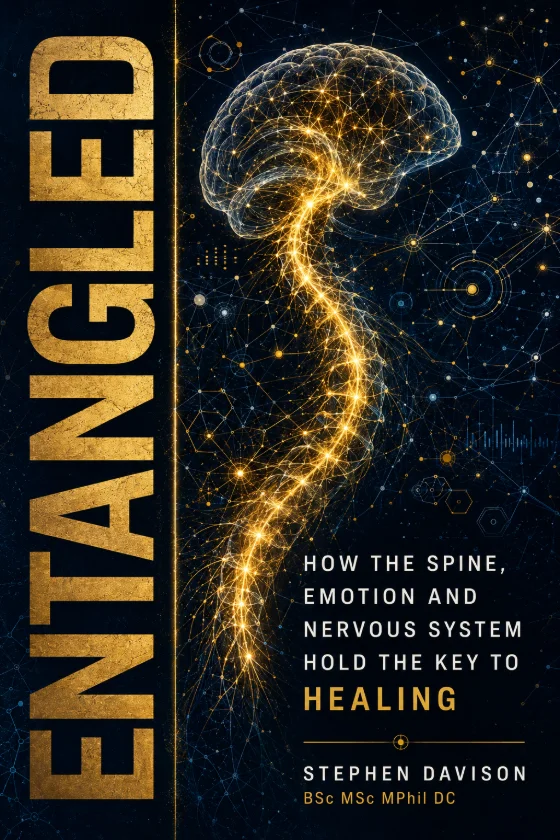
The book
How the spine, emotion and nervous system hold the key to healing
Why do some people stay stuck in cycles of pain, no matter what they try? In Entangled, Dr Stephen Davison — scientist, chiropractor and founder of the Elaris Healing System — reveals how the spine, nervous system and emotional patterns are woven together in ways most healthcare systems ignore.
Drawing on his background as an immunologist at King's College London and the University of Cambridge, and more than two decades treating thousands of patients, he shows why pain is never just a physical problem.
If you've struggled with long-standing back or neck pain, headaches or sciatica that hasn't settled, this book offers a new way to understand it.
Entangled isn't about chasing symptoms. It's about understanding the patterns behind them.
Stephen Davison BSc (Hons), MSc (Chiro), MPhil, DC · ISBN 978-1-7399927-4-3
Questions
No. The framework draws on peer-reviewed research in pain neuroscience, psychoneuroimmunology, and the neuroscience of stress and emotional experience. It is integrative — combining the structural precision of chiropractic with current science on how the nervous system generates and maintains persistent symptoms.
No. Many of the people we see have symptoms that don't fit a single diagnosis, or have been told nothing further can be found. That is not a barrier to being assessed here.
No. We work alongside your GP and any specialists involved in your care, not instead of them. Where something needs medical investigation we will say so and refer you on.
No. We do not make promises about outcomes. What we offer is a genuinely different clinical approach, designed for people whose pain has not settled with other approaches.
If something has been missed, the place to start is a proper assessment.
Book a new patient appointment