
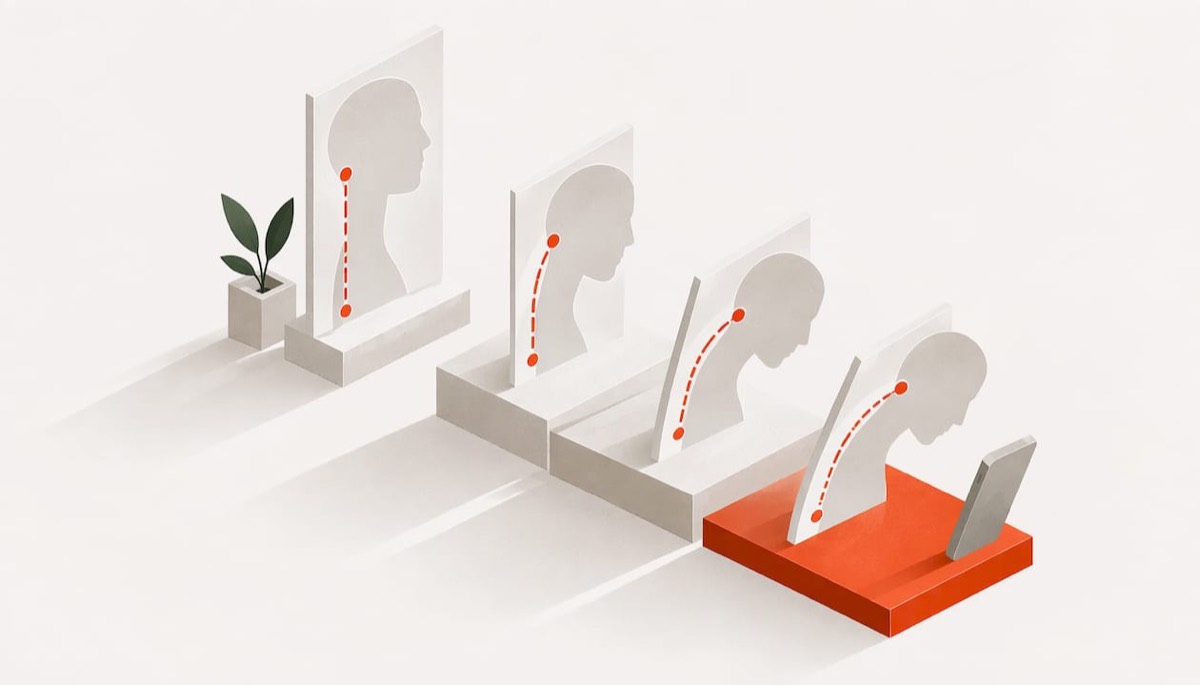

Text neck usually shows up as an aching, stiff neck and tight shoulders after long spells looking down at a phone or tablet. Many people also get tension headaches and discomfort between the shoulder blades. Most of these symptoms are mechanical and respond well to changes in posture, regular movement and, if they linger, a proper hands-on assessment. A small group of symptoms is different and needs a GP or emergency help, and we list those below so you can tell them apart.
TL;DR
- The most common text neck symptoms are neck pain, stiffness, soreness, tight shoulders, upper-back ache and tension-type headaches.
- Pain can sit in one spot or spread across the lower neck, and sometimes travels into the shoulders and arms.
- Researchers still debate how directly phone use causes neck pain, so a good assessment looks at the whole picture rather than blaming the screen alone.
- Sudden severe pain, pins and needles in an arm, weakness, or problems walking or speaking need urgent medical help, not a wait-and-see approach.
- If neck pain has not eased after a few weeks, book an assessment. Our first consultation and examination costs £105.
Table of Contents
- What text neck actually is
- The common symptoms of text neck
- A quick self-check list
- Why a forward head posture loads the neck
- Warning signs: when it is not text neck
- How to ease text neck symptoms
- Our view on text neck
- What a chiropractic assessment involves
- When to get neck symptoms assessed
- FAQ
- Sources
What text neck actually is
“Text neck” is a popular label rather than a formal diagnosis. It describes neck and upper-back problems linked to holding the head tilted forward and down for long periods, typically over a phone, tablet or laptop. Searches for “tech neck” mean the same thing.
A scoping review of how text neck is defined found that posture was the most common element in definitions, appearing in 92.7% of the 41 articles it examined. The same review concluded that there is no scientific evidence linking text neck with neck pain whichever definition is used. That does not mean your pain is imaginary. It means the cause is rarely one thing.
The NHS says the most common causes of neck pain include bad posture, such as sitting at a desk for a long time, the neck locking in an awkward position during sleep, a pinched nerve, or an injury such as whiplash. NICE’s clinical knowledge summary adds that non-specific neck pain is usually multifactorial, with poor posture, neck strain, sporting or work activities, anxiety and low mood all playing a part.
In practice, that matches what we see: a person who looks down at a screen for hours, sleeps awkwardly, carries stress in the shoulders and has not moved much that week is far more likely to hurt than someone with a single trigger.
The common symptoms of text neck
The pages that rank for this topic agree on a core list. Here is what to look for, in roughly the order people notice it.
Neck pain, stiffness and soreness
This is the headline symptom. Physiopedia describes the most common presentation as neck pain, stiffness and soreness, often a stiff neck and difficulty moving it after long device use. The pain may be in one spot or spread across the lower neck.
Many people notice it worst at the end of the working day, or the morning after a long evening of scrolling.
Tight, achy shoulders and upper back
When the head drifts forward, the muscles at the top of the shoulders and along the back of the neck work harder to hold it up. A 2025 scoping review of physiotherapy in text neck describes increased strain and stiffness in the upper trapezius and neck extensor muscles, together with weakness of the deep neck flexors. Over time, that muscle imbalance may overload the spine’s structures.
You might feel it as a heavy, knotted sensation across the shoulders, or a dull ache between the shoulder blades. Physiopedia also lists weakness in the shoulder muscles among the symptoms.
Tension-type headaches
Tightness in the small muscles at the base of the skull can lead to tension-type headaches, according to Physiopedia. Imperial College London’s occupational health team explains that leaning towards a screen with the chin forward creates neck muscle tension that can reduce blood flow to the head and cause headaches.
A headache that starts at the back of the head and creeps forward over the day, often easing when you change position, fits this pattern. If that sounds familiar, our guide to cervicogenic headache symptoms, causes and treatment explains the neck-to-head link in more detail.
Reduced movement
Physiopedia lists decreased range of movement in the neck and upper back as a feature. In real life this looks like struggling to check your blind spot when driving, or turning your whole body to look sideways because turning only your head feels tight.
Pain spreading into the arms
Text neck pain can radiate into the shoulders and arms. Imperial’s occupational health guidance notes that pressure on or around nerves in the neck can cause referred pain in the arms and hands. A dull ache that travels is one thing. Pins and needles, numbness or weakness is another, and belongs in the warning-signs section further down.
A quick self-check list
No list can diagnose you, but if several of these apply, your neck is asking for attention:
- Your neck or shoulders feel tight or sore by the end of the day.
- You get a nagging ache between the shoulder blades.
- Headaches begin at the base of your skull after screen time.
- Turning your head fully to one side feels restricted.
- Your shoulders have started to round forward, or your head sits ahead of your shoulders in side-on photos.
- Symptoms ease when you stop using your phone or laptop and move around.
That last point is useful. Symptoms that are clearly tied to posture and ease with movement are the typical mechanical pattern. Symptoms that do not change with position, or that wake you at night, deserve a closer look.
Why a forward head posture loads the neck
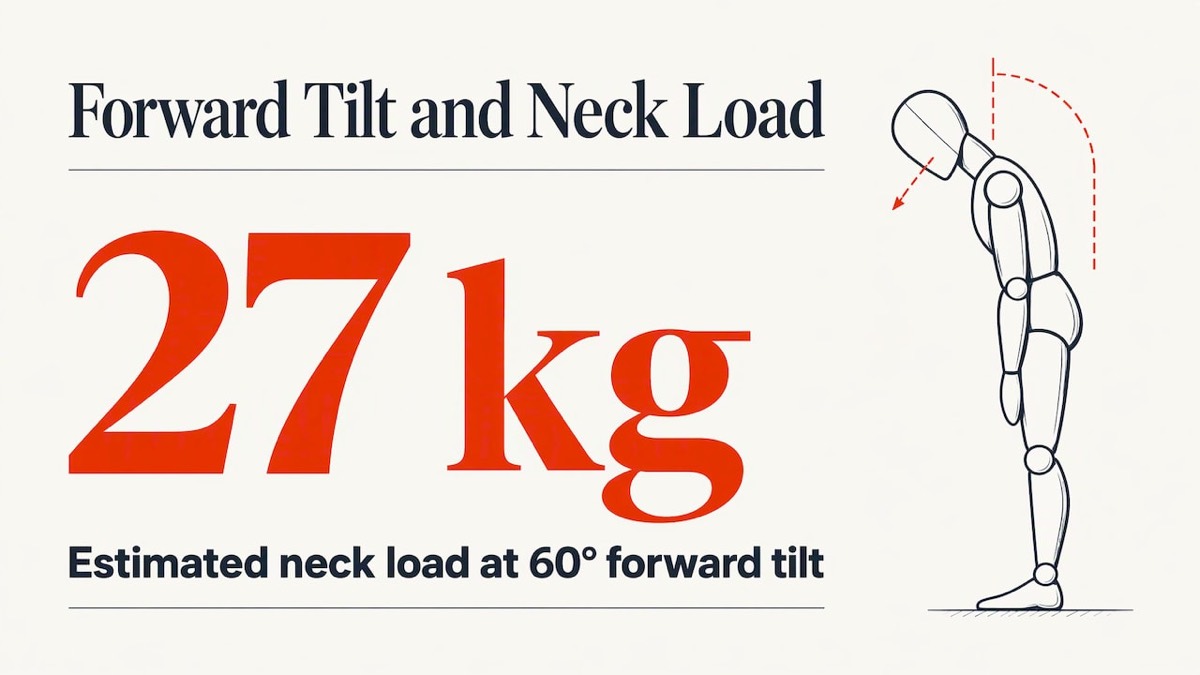
Your head is heavy and sits on a small stack of joints. One guide from a UK ergonomics firm puts an adult head at around 4.5 to 5.5 kg in a neutral position, rising to an estimated 27 kg of load on the neck at 60 degrees of forward tilt. Treat the exact figure as an estimate, but the principle is sound: the further forward the head, the harder the muscles work.
The Text Neck Syndrome review in PMC explains that forward head posture strains the joints and ligaments of the cervical spine and increases the gravitational pull on the muscles at the back of the neck. Its authors identify prolonged looking down with the neck flexed as the main aggravating factor, while acknowledging that how posture relates to neck pain still needs further study.
The Ergonomics Society points out that people naturally hold phones at chest height or lower, partly because holding them up is tiring and partly for screen privacy. Small text on high-resolution screens makes it worse because we lean in to read.
Who is more likely to get symptoms
The 2025 physiotherapy scoping review lists the risk factors it identified: how often and how long you spend in a poor position, where the device sits, how high you hold it, low physical activity, heavy smartphone use and female gender. Young people are affected too. The Royal Orthopaedic Hospital reports a rising number of young people referred to physiotherapy with tech neck, with children describing pain and tightness in the neck and shoulders.
Warning signs: when it is not text neck
Most neck pain is mechanical and settles. Some symptoms are not, and the right response is medical help, not stretching.
The NHS advises an urgent GP appointment or NHS 111 for:
- severe neck pain that starts suddenly or gets worse quickly
- heaviness or weakness in your arms or legs
- pins and needles in an arm alongside neck or arm pain
- pain between your shoulder blades
The same NHS page says to call 999 for new problems walking, loss of bladder or bowel control, sudden lack of coordination, a drooping face, being unable to lift both arms, or difficulty speaking.
NHS guidance on neck pain also says to see a GP if the pain followed a fall or trauma, or if dizziness, blackouts, double vision, slurred speech or trouble swallowing came after the neck pain began. If neck stiffness comes on quickly with stiffness in both shoulders, it can be a sign of polymyalgia rheumatica, which needs prompt treatment, so see your doctor as soon as possible.
NICE lists further red flag features that point to something more serious: neurological symptoms, fever, malaise, unexplained weight loss, unremitting pain that disturbs sleep, a history of violent trauma, cancer or neck surgery, or osteoporosis risk factors.
Pain between the shoulder blades can have several causes, and our article on shoulder blade pain and 999 red flags covers when it is urgent.
| What you notice | Likely response |
|---|---|
| Stiff, sore neck after screen time, easing with movement | Posture changes, regular breaks, gentle movement; book an assessment if it persists |
| Headache from the base of the skull, linked to desk or phone time | Review your set-up; consider an assessment if it keeps returning |
| Sudden severe neck pain, or pain that worsens quickly | Urgent GP appointment or NHS 111 |
| Pins and needles, weakness or heaviness in an arm or leg | Urgent GP appointment or NHS 111 |
| Trouble walking, loss of bladder or bowel control, drooping face, slurred speech | Call 999 |
How to ease text neck symptoms
The good news is that the habits that help are simple, free and well supported by UK guidance.
Raise the screen, rest the arms
The Ergonomics Society advises lifting the phone so your neck stays close to neutral, between eye height and about 15 degrees below horizontal, and resting your arms while you hold the screen higher. The Ergonix guide adds: avoid clamping the phone between shoulder and ear, and use an external keyboard for longer typing tasks.

Break it up
For mobile work, the Ergonomics Society recommends rest breaks of 2 to 5 minutes every 30 minutes in good conditions, and every 15 minutes in poor ones, plus micro-pauses of up to 30 seconds every 15 to 20 minutes. Voice commands and dictation cut down on typing and looking down.
Jodie Walters, a specialist physiotherapist at the Royal Orthopaedic Hospital, also advises taking movement breaks every 30 minutes, doing prescribed exercises to strengthen the neck and shoulders, and using relaxation techniques to break the cycle of holding one position.
Check your desk
If a monitor or desk is too low, the head bends forward for long periods and the neck muscles can ache. NHS physiotherapy guidance suggests checking the height of your desk and screen and the design of your chairs at work and at home. The HSE explains that the Display Screen Equipment Regulations apply to workers who use screens daily for an hour or more at a time, so if you work this way, ask your employer for a workstation assessment.
Build strength, not just stretches
Because weak deep neck muscles and tight upper shoulders are part of the pattern, strengthening the upper back helps hold your posture without effort. A guide to strength exercises for posture is a good place to pick movements that suit your routine. Start gently, and stop anything that sends pain or tingling down your arm.
Look at the rest of your day
Sleep position matters too. If you wake with a stiff neck or sore shoulders, our guide to pillow changes for side sleepers may help.
Our view on text neck
We rarely see a neck that hurts for just one reason. The phone gets the blame, but the people who come to us usually have a mix: a work set-up that has crept out of shape, stress held in the shoulders, a stiff upper back and a neck that has stopped moving as freely as it should.
That is why we do not start with a label. At Elaris we assess the structural, neurological and emotional factors behind your pain, because treating only the sore spot tends to bring only short-lived relief. A hands-on examination and neurological testing let us see how your neck, upper back and shoulders actually move, and whether anything points to a cause beyond posture.
You see the same two practitioners at every visit, your treatment plan is written down and explained, and we measure your progress at each stage. Our aim is for you to understand what is going on and to feel the difference, not simply to keep coming back.
— Dr Stephen Davison (Doctor of Chiropractic)
What a chiropractic assessment involves
If your neck has been sore for weeks, or the symptoms keep returning, an assessment is the sensible next step. We help people across Maldon, Tiptree, Great Totham and nearby Essex villages with neck and shoulder pain, headaches and related problems.
Your first consultation and examination costs £105. It includes a detailed history, a hands-on examination and neurological testing, and you leave with a clear explanation of what we found and a written treatment plan. Find out more about neck and shoulder pain care at Elaris, or book your first consultation directly.

If your symptoms include any of the warning signs above, contact your GP or NHS 111 first. We would rather you were seen quickly by the right service.
When to get neck symptoms assessed
The NHS says most neck pain only lasts a few weeks. It advises seeing a GP if the pain or stiffness does not go away after a few weeks, if painkillers have not worked, or if you have other symptoms such as pins and needles or a cold arm.
NICE says that for typical non-specific neck pain without red flags, management includes reassurance, education and lifestyle advice, exercise advice, analgesics and physiotherapy referral, and referral to a pain clinic for chronic pain lasting over 12 weeks that has not responded to primary care.
In plain terms:
- Days one to fourteen: keep moving, adjust your screen height, take regular breaks.
- Two to four weeks, no improvement: time for a professional assessment of your neck, upper back and shoulders.
- Any warning sign at any point: urgent medical help, as set out above.
If you also get back or leg symptoms, our pages on back pain treatment in Maldon and Tiptree and sciatica and leg pain explain how we approach them. Our article library covers further common complaints.
FAQ
How do I know if I have text neck?
The typical pattern is a sore, stiff neck and tight shoulders after long periods looking down, sometimes with an upper-back ache or a headache at the base of the skull. Symptoms that ease when you move or change position are the classic mechanical picture. Only an examination can confirm the cause, and any warning sign should go to a GP first.
Can text neck cause headaches?
Yes, tension-type headaches are a recognised part of the picture. Tight muscles at the base of the skull and a forward-leaning head can trigger them, and Imperial College London’s occupational health guidance links screen posture to muscle tension and headaches. Sudden, severe or unusual headaches are different and need urgent medical advice.
Can text neck cause tingling or numbness in the arms?
Pain that radiates into the shoulders and arms can occur, and pressure on neck nerves can cause referred symptoms. Pins and needles alongside neck or arm pain is, however, one of the symptoms the NHS says needs an urgent GP appointment or NHS 111 call, so do not wait it out.
How long does text neck take to go away?
The NHS says most neck pain lasts only a few weeks. Adjusting your screen height and taking regular breaks often helps within that time. If the pain has not improved after a few weeks, or keeps coming back, get it assessed.
What is forward head posture?
It is a posture where the head sits ahead of the shoulders instead of stacked over them. Research describes it as increasing the load on the joints and ligaments of the neck and the muscles at the back of it, which is why it is so often linked with stiffness and ache.
Sources
- Defining text neck: a scoping review (PubMed)
- Neck pain: non-specific (NICE CKS)
- Neck pain and stiff neck (NHS)
- Text Neck (Physiopedia)
- Physiotherapy in Text Neck Syndrome: A Scoping Review (PMC)
- Text Neck Syndrome: Disentangling a New Epidemic (PMC)
- Neck pain in office workers (Imperial College London)
- Looking after your neck when using phones and tablets (Ergonix)
- Mobile Working Risk Management System (Ergonomics Society)
- From Tablets to Text Neck (Royal Orthopaedic Hospital)
- Cervical spondylosis (NHS)
- Neck pain (NHS Dynamic Health)
- Neck pain guidance (NHS Cheltenham physiotherapy)
- Working safely with display screen equipment (HSE)
- Exercises for posture (RIRLift)