
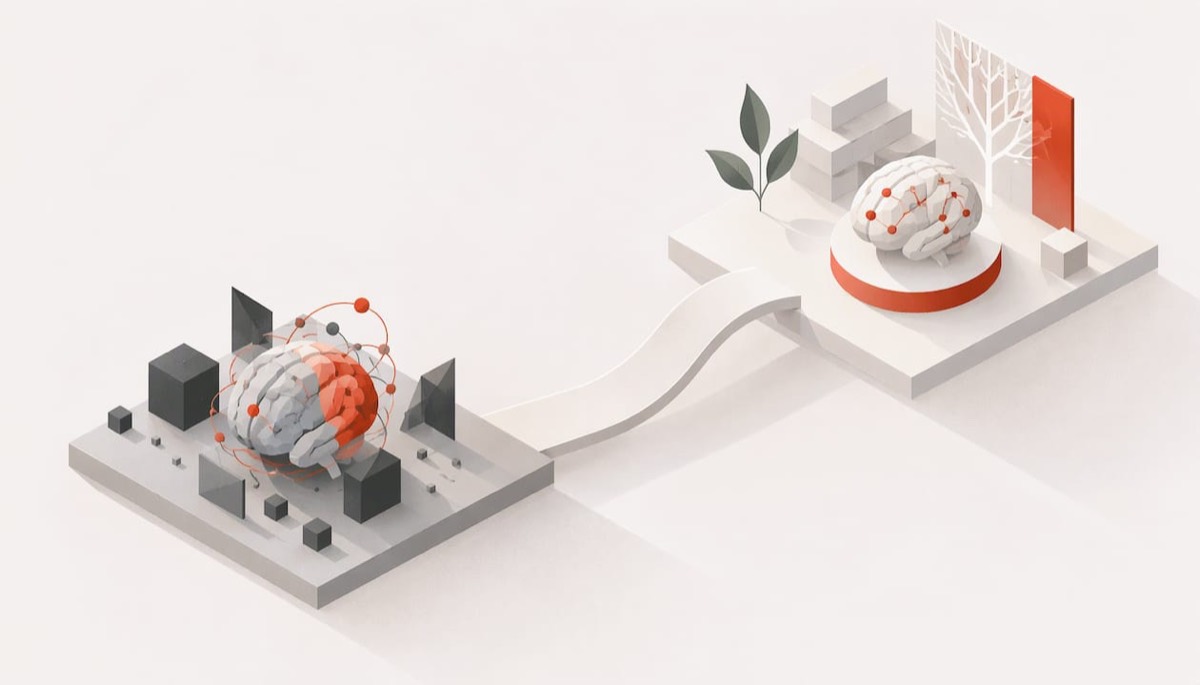

Pain neuroscience education (PNE) is a way of teaching people how pain works, so that persistent pain feels less threatening and movement feels safer. It explains that pain is produced by the nervous system as a protective response, not simply read off the state of your tissues. It tends to work best alongside active care such as movement, exercise and hands-on treatment, not on its own. If you live with back, neck or sciatic pain, understanding it can be one useful part of getting your life back.
TL;DR
-
PNE teaches that pain is a danger signal produced by the nervous system, not a precise measure of damage.
-
Research reports benefits for knowledge, fear of pain and catastrophising, while results for pain and disability are mixed.
-
It is usually delivered as part of a wider package that includes exercise, sleep and goal setting.
-
Back, neck and sciatic pain still deserve an individual assessment, and some symptoms need urgent care.
-
At Elaris in Great Totham, your first consultation and examination is £105, with an explained plan afterwards.
Table of Contents
What pain neuroscience education actually is
PNE teaches people about the neuroscience and neurophysiology of pain. Its central aim is to shift how you think about pain, from a “damage signal” to a “danger signal”. Your nervous system weighs up information from your body, your surroundings, your past experiences and your mood, then decides whether to turn the alarm up.
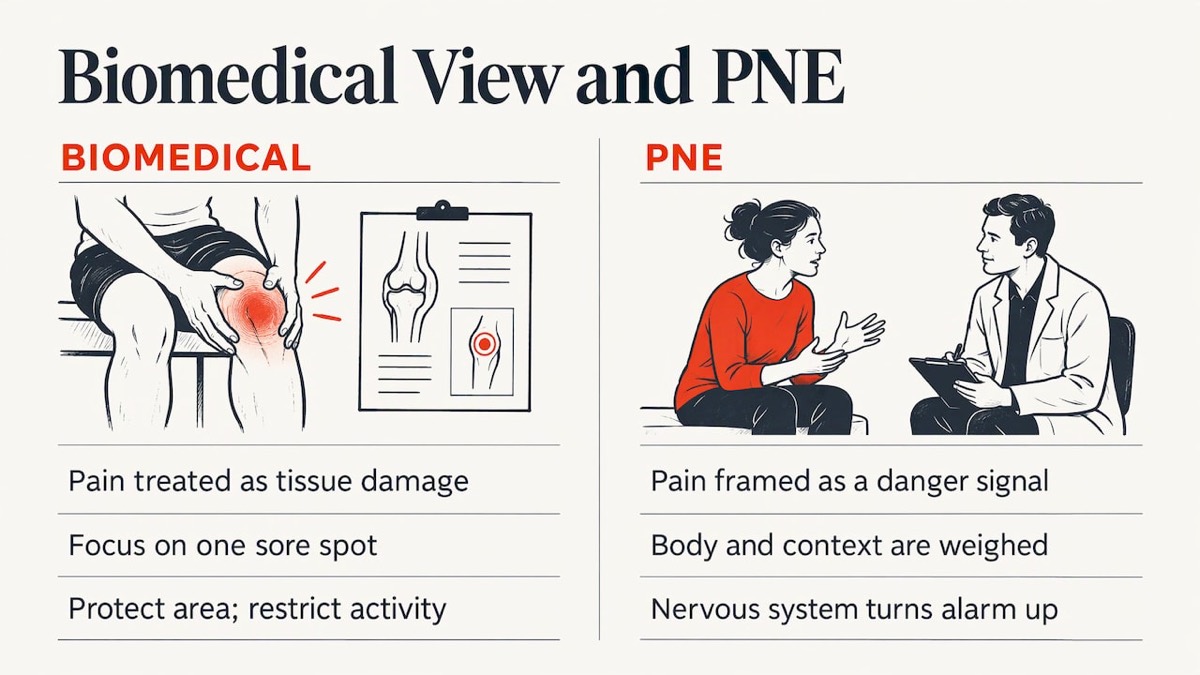
The older, purely biomedical way of explaining pain is more local. It treats pain as the result of tissue damage in one spot, which suggests that the sore area must be protected and that work or activity should be restricted. A 2021 editorial in PMC argues that this message can reinforce unhelpful beliefs, negative emotions and fear of movement. PNE sets out to change those beliefs and the avoidance behaviours that follow from them.
The field has also moved on. A 2025 review led by Professor Lorimer Moseley notes that the research collaboration behind it now prefers the term Pain Science Education, because modern programmes draw on more than neuroscience and use ideas from education science. You will see both names in the literature and they describe the same family of approaches.
How it explains persistent back, neck and sciatic pain
The core message is that pain is often not a reliable gauge of tissue health. A 2024 narrative review summarises it this way: pain results from your nervous system interpreting an injury together with psychological and social factors.
In practice, that explains several things people find confusing:
-
Pain that outlasts healing. Chronic pain is usually defined as pain lasting beyond normal tissue healing time, taken to be three months, according to Scottish guidance on chronic pain. A back that has had months to heal can still hurt because the nervous system has become more protective.
-
Pain that does not match the scan. Many people have changes on an image and no pain, and others have pain with an unremarkable image. The nervous system’s reading of danger matters as much as the structure.
-
Flare-ups after stress or poor sleep. Mood, tiredness and worry can turn the sensitivity up, which is why a stressful week can make your neck feel worse without any new injury.
-
Sciatic pain that spreads or changes. Leg symptoms can be driven by an irritated nerve and by a nervous system that has become more reactive.
We write about the sensitised nervous system in more detail in our guide to central sensitisation, its symptoms, causes and what helps.
This is not the same as saying pain is imaginary. The pain is real. PNE explains why it can be real, persistent and still not mean that something is badly damaged.
How common is persistent pain in the UK?
If you live with pain every day, you are far from alone. The Faculty of Pain Medicine’s core standards report that 31 to 37% of the population experience persistent or chronic pain, and that for about half of them, around eight million people in the UK, pain significantly interferes with function and quality of life. The Scottish guideline puts “significant” chronic pain at around 14% of UK adults.
The gap between those figures reflects how pain is defined and measured. The practical point is the same: persistent pain is common, and understanding it is a legitimate part of care.
What happens in a PNE session
There is no single format. PNE can be given in one session or several, one-to-one or in groups, and through written material, face-to-face conversation or online video, according to the PMC editorial. Typical ingredients include:
-
Plain-language explanations of how nerves, the spinal cord and the brain handle danger signals.
-
Metaphors and drawings that make abstract ideas easier to hold on to, such as an alarm system set too sensitively.
-
Stories and examples from everyday life, so the ideas connect to your own symptoms.
-
A link to action, such as a gradual return to the walking, lifting or sport that matters to you.
How much education is enough? The 2024 narrative review estimates that 100 to 200 minutes is the best dose for fear of movement and anxiety, and around 400 minutes for pain catastrophising. These are estimates drawn from trials that vary widely, so treat them as a rough guide to the fact that understanding takes more than a single conversation.
Why education sits alongside movement
PNE is usually delivered as part of a package that includes exercise, sleep hygiene and goal setting. The editorial authors state that when PNE is combined with active treatment such as exercise, results for pain and disability are better than with education alone. The British Pain Society’s guidelines for pain management programmes take the same line: pain science education is worth considering to address misconceptions, and it appears more effective as part of a package of care than in isolation.
That matches common sense. Once you understand that a movement is not dangerous, you still need to practise it. If you want to see how a structured plan can be built around steady, graded activity, this active recovery week plan shows one way to think about pacing effort and rest.
What the research shows
The evidence is encouraging and also still developing, and it helps to know both sides.
A 2025 review in Frontiers in Pain Research counts more than 35 trials of PNE on its own and over 50 trials of more complex interventions that include PNE content. Some conclude that PNE brings small to medium benefits across outcomes. Others find gains in knowledge, catastrophising and fear of pain, but not always in pain intensity or disability.
The same group reports something worth taking seriously. In clinical audit, when the learning goals of PNE are achieved, patients tend to gain excellent and sometimes transformative results. Yet those goals are met in about 50% of patients, and pain and disability did not improve in people whose understanding did not change.
What does that tell you? Three practical things:
-
Understanding is the active ingredient. What counts is whether the explanation lands for you, not whether you were handed a leaflet.
-
Delivery matters. Clear, personal and repeated explanations, tied to what you want to do again, seem to work better than a one-off talk.
-
People differ. The British Pain Society guidelines note that many people benefit from an up-to-date pain science explanation to guide the changes they value, while others make those changes without needing it first.
The authors of the Frontiers review argue that the field should move from didactic lectures towards co-design, sequential art and embodied learning. In plain terms, education works better when it is interactive, relevant and built around your own goals.
Can it help after a recent injury, not only chronic pain?
Yes, the ideas are not limited to long-standing pain. A 2024 commentary on PNE for acute pain notes that research on education before lumbar surgery, knee replacement and shoulder surgery has shown positive effects on surgical outcomes, patient experience, nervous system sensitisation and post-surgery healthcare costs.
For a recent back strain or a stiff neck after a long week, the same principle applies. Knowing that most flare-ups are your body being protective, and that gentle, early movement is usually part of recovery, can stop a short episode turning into a long one. That is the thinking behind advice to stay active rather than rest for days.
Why it is not always easy to deliver
The Moseley review lists the barriers clinicians report: limited appointment time, patients who do not see education as a treatment in its own right, and clinicians who lack confidence in how to deliver it. The only major implementation trial of physiotherapists trained in PNE, with 16 hours of training, improved patients’ pain-related self-efficacy, meaning their confidence in managing their pain.
Time is the biggest of these. Good explanation cannot be rushed into the last two minutes of a session. Services built around coordinating care for people with long-term pain, such as this overview of chronic pain management support, reflect how much of the work lies in organisation, continuity and giving patients time.
Our perspective
We see the same pattern in the clinic again and again. Someone arrives with months of back pain, a long list of things they have stopped doing, and a quiet belief that something in their spine is badly broken. The first thing that helps is often not a technique. It is a clear, calm explanation of what is going on.
That is why our assessments are unhurried. We look at structural, neurological and emotional factors together, because pain rarely has one cause. We carry out a hands-on examination and neurological testing, then explain what we found in plain words and set it out in a written treatment plan. You see the same two practitioners each visit, so the explanation builds over time instead of starting again every appointment.
Understanding pain and hands-on care work together. When you know why your nervous system has become protective, movement feels less risky. Treatment and guided activity then give your body real experience of moving well, and we measure progress at every stage so you can see it for yourself. Our approach, the Elaris Method™, is designed around finding and addressing the root causes of pain, not only the symptoms. After more than 25 years in practice, that is the approach we believe gives people the best chance of lasting change.
— Dr Stephen Davison (Doctor of Chiropractic)
When to get an individual assessment
Education about pain is useful, but it does not replace being examined. Back, neck and leg pain can have causes that need a proper look, and an examination tells you which category you are in.
Some symptoms are urgent. NHS guidance for England says that people with nerve root pain and red flags such as objective weakness, sexual dysfunction or cauda equina syndrome need urgent referral to an acute spinal centre. An NHS hospital awareness document adds that if you have sciatica and develop symptoms suggesting cauda equina syndrome, you should seek emergency medical help, because it can only be confirmed or excluded by an emergency spinal MRI scan.
In practice, go to A&E or call 999 if you notice any of the following with back or leg pain:
-
numbness around the genitals, buttocks or inner thighs
-
new difficulty passing urine or controlling your bowels
-
new sexual dysfunction
-
weakness in a leg that is getting worse
For most people, the picture is less dramatic. The NICE guideline NG59 on low back pain and sciatica offers tools including the STarT Back screening tool, which matches the type of support to how likely the pain is to become persistent. The same logic is behind a careful first assessment: the right plan depends on you.
How we put this into practice at Elaris
If you are in Maldon, Tiptree, Great Totham or the surrounding Essex villages, your first step is a consultation and examination. Our first consultation and examination costs £105. It includes a hands-on exam and a clear explanation of what we find, so you leave knowing where you stand and what comes next.
We see people for a range of problems, each with its own page:
-
Low back pain, including stiffness that keeps returning
You can read more about how we assess people with long-standing symptoms on the Elaris approach page. If you want to know what treatment itself feels like, our guides to types of chiropractic adjustments and gentle chiropractic techniques explain the options. More articles on persistent pain are collected on our blog.
Making the most of what you learn about pain
Whether you learn it from a clinician, a book or a video, a few habits help the ideas stick:
-
Write down your own pain story. Note when it started, what makes it worse, and what you have stopped doing. This gives your clinician a clearer picture and gives you a baseline.
-
Choose one valued activity. A walk to the shop, lifting a grandchild, a round of golf. Education works best when it is tied to something you want to do.
-
Pace, do not push. Increase activity in small, planned steps, not in bursts after good days followed by crashes.
-
Look after sleep and stress. Both change how sensitive your nervous system is, so they are part of the plan and not an afterthought.
-
Review progress regularly. Measuring change, whether in distance walked or days with fewer symptoms, shows you that your pain is changing even when it is not gone.
FAQ
Is pain neuroscience education the same as saying the pain is in my head?
No. PNE starts from the fact that your pain is real. It explains that pain is produced by the nervous system and influenced by many factors, including tissue health, stress, sleep and past experience. The aim is to make sense of why pain persists, not to dismiss it.
How long does it take to work?
It varies. Research suggests that 100 to 200 minutes of education is optimal for fear of movement and anxiety, and around 400 minutes for catastrophising, usually spread across several sessions. Understanding tends to build over time, especially when it is paired with movement and treatment.
Do I need PNE if I have sciatica?
Not everyone does, and what you need depends on an examination. Sciatica can involve an irritated nerve and a sensitised nervous system, so understanding both can help. Anyone with leg weakness, numbness around the genitals or changes in bladder or bowel control needs emergency medical care, not education.
Can pain education replace exercise or hands-on treatment?
It is designed to work with them. Academic reviews report better pain and disability outcomes when education is combined with active treatment such as exercise. At Elaris, explanation, hands-on care and guided activity sit together in one written plan.
What should I expect at a first chiropractic appointment?
At Elaris, you can expect a detailed history, a hands-on examination and neurological testing. We then explain what we found and what we recommend. The first consultation and examination is £105.
Sources
-
Moseley et al., Pain Science Education review (Teesside University)
-
Pain Neuroscience Education and Neuroimaging: A Narrative Review (PMC)
-
Faculty of Pain Medicine Core Standards for Pain Management Services in the UK
-
British Pain Society Guidelines for Pain Management Programmes for Adults
-
From didactic explanations to co-design (Frontiers in Pain Research)
-
Cauda Equina Syndrome Awareness (Oxford University Hospitals)