
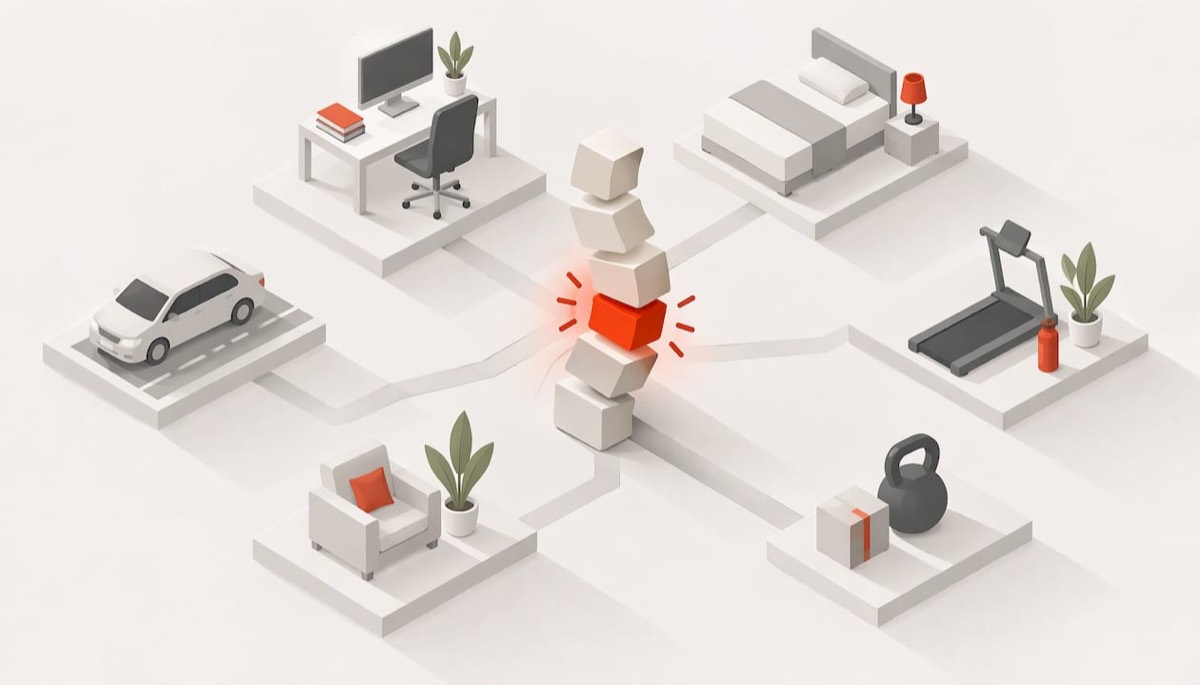

Most lower back pain comes from the muscles, ligaments and joints of the spine being irritated or overloaded, not from a serious disease. The World Health Organization says about 90% of low back pain is non-specific, meaning no single disease or damaged tissue fully explains it. That does not make it imaginary or unfixable. It means the cause is usually a mix of movement, load, sleep, stress and how your spine is working. A small number of causes are serious, and you will find the warning signs below.
TL;DR
- The most common cause is a strain or sprain of the muscles and ligaments, often after lifting, twisting or an unaccustomed activity.
- Discs, irritated nerves (sciatica), stiff joints and spinal wear can also cause lower back pain, and these often send pain into the buttock or leg.
- Stress, poor sleep, low mood and inactivity make the back more sensitive and can keep pain going.
- Pain in both legs, numbness around the genitals or anus, or bladder or bowel changes need 999 or A&E straight away.
- If pain is not improving after a few weeks, a hands-on assessment can help find what is driving it.
Table of Contents
- The most common causes of lower back pain
- Why does my lower back hurt when I have not injured it?
- How stress, sleep and mood affect your back
- Warning signs: when lower back pain needs urgent care
- Causes at a glance
- Do you need a scan to find the cause?
- Our perspective on finding the real cause
- How to reduce the chance of it coming back
- Book an assessment at Elaris in Great Totham
- FAQ
- Sources
The most common causes of lower back pain
The NHS says a common cause of back pain is an injury such as a pulled muscle (strain), and that conditions such as a slipped disc, sciatica or ankylosing spondylitis can also be responsible. Here is how the main causes tend to show up.
Muscle and ligament strain
This is the everyday culprit. You lift a bag awkwardly, spend a weekend in the garden, twist to reach something in the car, and the next morning the lower back is tight, sore and reluctant to bend. Pain is usually felt across the lower back, sometimes more on one side, and it eases a little when you find a comfortable position and flares with certain movements.
Milton Keynes University Hospital advises that most cases of lower back pain last only a few days and improve on their own. Staying gently active usually serves you better than prolonged rest.
Disc problems
The discs between your vertebrae act as cushions. A disc can bulge or herniate (a “slipped disc”, though the disc does not actually slip) and press on a nearby nerve. Typical signs are lower back pain that is worse on bending or sitting, and pain that travels into the buttock or leg. Our article on lumbar radiculopathy symptoms explains the clues that point to a nerve root being involved.
Sciatica and nerve irritation
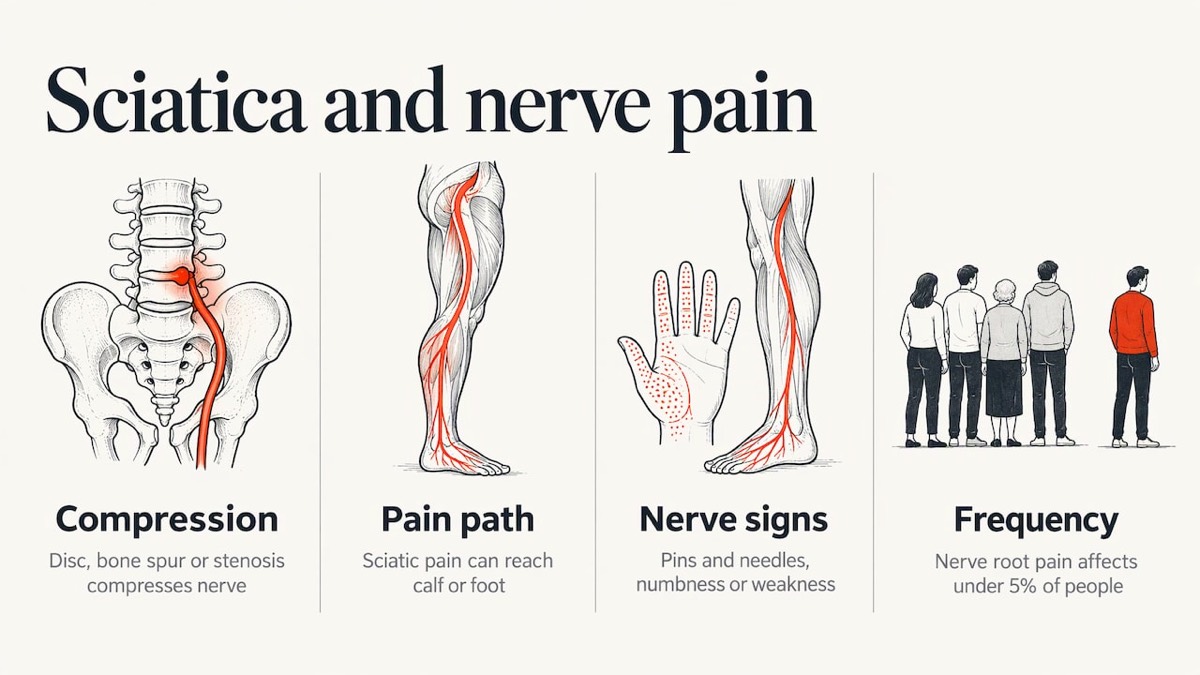
St George’s Hospital says sciatica most commonly happens when a herniated disc, bone spur or spinal stenosis compresses part of the nerve, causing inflammation, pain and often some numbness in the leg. Milton Keynes University Hospital notes that nerve root pain is the cause of lower back pain in less than 5% of people. So if your pain stays in the back, sciatica is statistically less likely than a simple mechanical cause.
The giveaway is where the pain goes. Sciatic pain follows the path of the nerve down the leg, sometimes to the calf or foot, and can come with pins and needles, numbness or weakness. If that sounds familiar, see our page on sciatica and leg pain treatment near Maldon.
Stiff or irritated spinal joints
The small facet joints at the back of the spine and the sacroiliac joints at the base can become stiff, irritated or poorly coordinated. This often feels like a deep, localised ache to one side of the lower back, worse after sitting for a long time and easing as you move around. These are mechanical problems, and they are among the things a hands-on examination is designed to pick up.
Wear and age-related change
Arthritis UK lists spondylosis, slipped disc, sciatica and spinal stenosis as common conditions behind back pain, and says they are usually not serious. If they get worse or start to affect everyday life, it advises seeing your GP. Spinal changes that appear on a scan are also very common in people with no pain at all, which is one reason the picture on an image does not always match how you feel. If you are wondering what imaging can and cannot tell you, our guide to X-ray versus MRI walks through it.
Referred pain from the hip, buttock and tailbone
Not every ache in the lower back starts there. Tight or weak gluteal muscles, a trapped nerve deep in the buttock or an irritated tailbone can all feel like a back problem. Two articles of ours cover these in detail: deep gluteal syndrome and dead butt syndrome. If sitting is the main trigger, read about tailbone pain when sitting.
Why does my lower back hurt when I have not injured it?
This is the question behind most searches, and the answer surprises people. South Tees NHS explains that a lot of low back pain begins with no injury or with simple everyday movements, and may be linked with stress, tension, fatigue, inactivity or unaccustomed activity, which make the back more sensitive to movement and loading.
In practice, the back is rarely hurting for one reason alone. A typical story looks like this:
- A desk job with long periods of sitting and little variety of movement.
- A few weeks of poor sleep or a stressful period at work or home.
- A burst of unusual activity, such as a DIY weekend, a long drive or a return to the gym.
- A back that was already a little stiff or under-conditioned reacts with pain.
No single step is dramatic, yet the pain is real. The WHO lists low physical activity, smoking, obesity and high physical stress at work as risk factors for non-specific low back pain.
What about sudden pain that lasts only seconds?
Brief, sharp twinges are very often muscular or joint-related: a muscle briefly spasming, or a joint or nerve being pinched for a moment when you twist or stand up. If they are isolated, settle straight away and you feel otherwise well, they are usually not a cause for alarm. If they keep coming back, are getting more frequent, spread into the leg or come with any of the warning signs below, mention them to your GP.
How stress, sleep and mood affect your back
Back pain is not “all in the mind”, and it is not purely a mechanical fault either. Emotional and lifestyle factors change how sensitive the back is and how long pain lasts.
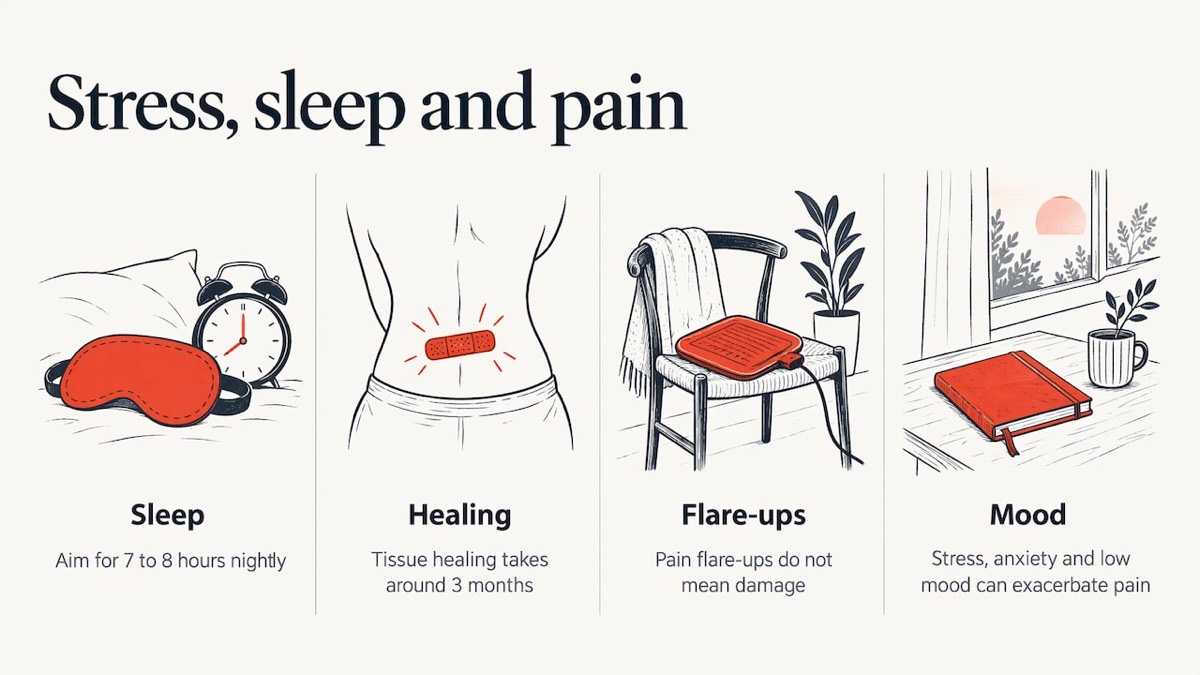
St George’s Hospital states that stress, anxiety and low mood can exacerbate existing back pain, and recommends aiming for 7 to 8 hours of sleep a night. South Tees NHS says pain flare-ups do not mean you are damaging yourself, and that common triggers include poor sleep, stress, tension, worry, low mood and inactivity. It adds that if an injury has occurred, tissue healing takes around 3 months, so pain beyond that usually means other contributing factors are involved.
This is why a proper assessment looks at more than the spine. Where you hold tension, how you sleep, how you move at work and what is going on in your life all belong in the picture.
Warning signs: when lower back pain needs urgent care
The serious causes are uncommon. St George’s Hospital says less than one per cent of people present with a serious cause for their back pain. But they matter, so know the signs.
Call 999 or go to A&E if you have any of these, according to the NHS:
- pain, tingling, weakness or numbness in both legs
- loss of feeling around your genitals or anus
- changes in how your bladder or bowels work
- back pain that started after a serious accident
These can signal cauda equina syndrome. Oxford University Hospitals says it is very rare, affecting 1 to 3 in 100,000 people, and that treatment before symptoms become severe reduces the risk of permanent disability. It needs immediate emergency assessment. Do not wait for a routine appointment, and do not book a chiropractor first.
Ask for an urgent GP appointment or call 111 if you have back pain and feel hot, cold, shivery or generally unwell, or if the pain is severe, started suddenly or is getting worse quickly.
See your GP if the pain has not improved after a few weeks, is stopping you doing daily activities, is worse at night, or you have lost weight without trying.
NICE’s clinical knowledge summary lists the red flags clinicians look for: spinal fracture, cancer, infection and cauda equina syndrome. For cancer, the features include being aged 50 or over, gradual onset, night pain and unexplained weight loss. For infection, they include fever, a recent infection or a weakened immune system.
One more inflammatory cause is worth knowing about. Ankylosing spondylitis tends to affect younger people, with morning stiffness, night pain and symptoms lasting more than 3 months, as summarised in the Edinburgh GP Handbook. Our guide to ankylosing spondylitis symptoms covers the early signs.
Causes at a glance
| Likely cause | What it often feels like | Where it tends to hurt |
|---|---|---|
| Muscle or ligament strain | Tight, sore, worse on certain movements | Across the lower back, sometimes one side |
| Disc problem | Worse on bending or prolonged sitting | Lower back, may spread to buttock or leg |
| Sciatica (nerve root irritation) | Shooting or burning pain, pins and needles, numbness | Down the leg, possibly to calf or foot |
| Joint stiffness (facet or sacroiliac) | Deep ache, stiff after sitting, eases with movement | One side of the lower back or base of spine |
| Inflammatory (such as ankylosing spondylitis) | Morning stiffness, night pain, lasting over 3 months | Lower back and buttocks |
| Serious cause (rare) | Fever, unexplained weight loss, bladder or bowel change, numb saddle area | Varies, needs urgent medical assessment |
This table is a guide to patterns, not a diagnosis. Only an examination can tell which applies to you.
Do you need a scan to find the cause?
Usually not. Milton Keynes University Hospital says X-rays or scans are not helpful for most people with back pain, and that a conversation and an examination are normally enough. NICE guidance says imaging should not routinely be offered in a non-specialist setting, and considered by specialists only if the result is likely to change management.
The examination is where the answers come from: how you move, which movements reproduce your pain, how your nerves are responding, and what your history says about triggers.
Our perspective on finding the real cause
We see the same pattern again and again at the clinic. Someone arrives with a sore lower back and has been told it is “just a strain”, or has been treated where it hurts without anyone asking why it started.
Our view is that pain is a signal, and the useful question is what is producing it. That is why the Elaris Method™ looks at three things together: the structure of the spine and the way it moves, the nervous system and how your nerves are behaving, and the emotional and lifestyle load you are carrying. Each can keep a back painful, and ignoring any one leaves part of the story untold.
We also believe you deserve time. You see the same two practitioners at every visit, your examination is hands-on, your treatment plan is written down and explained, and we measure your progress at each stage so you can see where you are heading.
If your pain has outlasted a few weeks, or keeps returning, finding the cause is the most useful step you can take.
— Dr Stephen Davison (Doctor of Chiropractic)
How to reduce the chance of it coming back
NICE recommends group exercise programmes for people with a flare-up of low back pain, and supports a return to work and normal activities. In practice:
- Keep moving. Short, regular changes of position beat one long stretch in the same posture.
- Build up gradually. Unaccustomed activity is a common trigger, so increase loads and time in steps.
- Protect your sleep. Aim for the 7 to 8 hours that St George’s Hospital recommends.
- Take stress seriously. Tension and worry are on the list of triggers in the South Tees leaflet, so managing them is part of back care, not a distraction from it.
- Do not read a flare-up as damage. Pain returning does not mean you have harmed your spine again.
NICE CKS also recommends using a risk tool such as the Keele STarT Back screening tool to identify people more likely to have a prolonged recovery, so the level of support can be matched to the person. That fits how we work: someone with several risk factors needs a more thorough plan than someone with one.
Book an assessment at Elaris in Great Totham
If your lower back pain has lasted more than a few weeks, keeps coming back or travels into your leg, we can examine you and explain what we find. Your first consultation and examination costs £105. It includes a hands-on examination and neurological testing, and you leave knowing what is likely behind your pain and what the plan is.
We see patients from Maldon, Tiptree, Great Totham and the surrounding Essex villages. Read about back pain treatment in Maldon and Tiptree, or book your first consultation directly. If you have any of the emergency symptoms above, go to A&E first.
FAQ
Why does my lower back hurt when I haven’t done anything?
Pain often starts with no clear injury. South Tees NHS links it to stress, tension, fatigue, inactivity or unaccustomed activity, which make the back more sensitive to movement. Poor sleep and low mood add to this. A hands-on examination can show which factors are involved in your case.
Is lower back pain usually serious?
No. The WHO says about 90% of low back pain is non-specific, and St George’s Hospital says fewer than one per cent of people have a serious cause. Learn the warning signs, such as numbness around the genitals or anus or bladder and bowel changes, and seek emergency help if they appear.
Can stress and poor sleep cause lower back pain?
They can make it worse and help it last longer. St George’s Hospital says stress, anxiety and low mood can exacerbate existing back pain, and Newcastle Hospitals NHS says work stress, sleep and major life events affect severity and duration. Addressing them alongside movement and treatment is sensible.
When should I see a chiropractor rather than a GP?
See a GP or call 111 first if you feel unwell with a fever, have unexplained weight loss, night pain or sudden severe pain. For mechanical pain that is not settling after a few weeks, or keeps returning, a chiropractic assessment is a sensible next step. Go to A&E for the emergency signs listed above.
Sources
- Back pain - NHS
- Low back pain - World Health Organization
- Lower back pain advice - Milton Keynes University Hospital
- Back Pain Advice - St George’s Hospital
- Back pain - Arthritis UK
- 10 Back Facts - South Tees NHS
- Cauda Equina Syndrome Awareness - Oxford University Hospitals
- Back pain - low, assessment - NICE CKS
- Low back pain and sciatica in over 16s: recommendations - NICE NG59
- Low back pain - The Edinburgh GP Handbook