


Frozen shoulder (adhesive capsulitis) usually moves through three overlapping stages: a painful freezing stage, a stiff frozen stage and a gradual thawing stage. Together they commonly take well over a year. The NHS guidance on frozen shoulder says the condition usually resolves eventually, but it can take months or even years. Knowing which stage you are in helps you decide what to do, what to avoid and when to have it looked at.
This guide walks through each stage in plain English, with typical timings, night-time advice and the signs that mean you should not wait. We are a chiropractic clinic in Great Totham, so we also explain how we assess a shoulder like this.
TL;DR
- Frozen shoulder has three overlapping stages: pain-predominant (freezing), stiffness-predominant (frozen) and resolution (thawing).
- Typical timings are 2 to 9 months, 4 to 12 months and 12 to 42 months, but the boundaries are not exact and everyone differs.
- Night pain is common early on. Supporting the arm with pillows and avoiding lying on the sore side can help.
- Do not force movement through sharp pain. Keep the arm gently moving within what is comfortable.
- If pain or stiffness has not eased after a few weeks of self-help, or you have any warning signs, get it assessed.
Table of Contents
- The three stages of frozen shoulder at a glance
- Stage 1: the freezing (painful) stage
- Stage 2: the frozen (stiff) stage
- Stage 3: the thawing (resolution) stage
- Why a frozen shoulder hurts more at night
- What helps at each stage
- What to avoid with a frozen shoulder
- Frozen shoulder or rotator cuff problem?
- When to get your shoulder assessed
- How we help at Elaris Chiropractic
- FAQ
- Sources
The three stages of frozen shoulder at a glance
Clinicians describe the condition as pain-predominant, stiffness-predominant and resolution. NHS Gloucestershire’s clinical guidance gives typical durations of 2 to 9 months for the first, 4 to 12 months for the second and 12 to 42 months for the third. Many patients and websites use the friendlier names freezing, frozen and thawing. You may also see a fourth, “pre-freezing” stage mentioned, which describes the earliest, mild aching before the pattern is obvious.
| Stage | Also called | Typical length | Main experience |
|---|---|---|---|
| 1 | Pain-predominant, freezing | 2 to 9 months | Constant, often severe pain, worse at night, movement starts to shrink |
| 2 | Stiffness-predominant, frozen | 4 to 12 months | Pain eases, stiffness dominates, rotation is hardest |
| 3 | Resolution, thawing | 12 to 42 months | Movement slowly returns |
The phases overlap. The South Tees NHS physiotherapy booklet notes that stage boundaries are not exact, which is why many clinicians now simply ask whether your shoulder is mainly painful or mainly stiff. Timings also differ between sources. NHS Tayside’s guidance gives a freezing stage of 6 weeks to 9 months, and Sussex Community NHS says recovery commonly takes 18 months to 3 years overall. Treat all of these as ranges, not deadlines.
Stage 1: the freezing (painful) stage
This is usually the hardest stage to live with. The NHS lists pain as one of the two main symptoms, often worse at night and disturbing sleep. South Tees describes the pain in this phase as potentially constant, severe at rest or with movement, and bad enough that lying on the affected side may be impossible.
What you may notice:
- A deep ache in the shoulder, sometimes spreading down the upper arm.
- Pain that wakes you or stops you getting comfortable in bed.
- Reaching, dressing and carrying becoming awkward, even though you can still move the arm.
- Movement gradually shrinking as the weeks pass.
The priority at this point is calming pain while keeping the shoulder gently moving. South Tees advises prioritising pain management and gentle range-of-motion exercise within tolerance in the painful phase. The key phrase is within tolerance: movement should feel like a stretch or a mild ache, not a sharp stab.
Stage 2: the frozen (stiff) stage
In the second stage the constant pain usually improves, but the shoulder tightens. According to South Tees, night symptoms become more manageable, and the restriction is especially noticeable with rotation, such as reaching behind your back or your head.
Typical everyday signs:
- Difficulty fastening a bra, tucking in a shirt or reaching a back pocket.
- Trouble washing your hair or reaching a high shelf.
- Sharp twinges at the end of range rather than a constant ache.
- The other muscles around the neck and shoulder blade working overtime to compensate.
That last point matters. When the shoulder joint itself will not move, the neck, upper back and shoulder blade take the strain, and many people notice tightness there. If this sounds familiar, our guides on levator scapulae pain and shoulder blade pain cover related problems.
Diagnosis is based on your history and an examination. The BESS/BOA patient care pathway describes global restriction of both active movement (you moving it) and passive movement (someone else moving it), especially external rotation, which is turning the arm outwards. X-rays can be used to exclude other causes such as arthritis or dislocation.
Stage 3: the thawing (resolution) stage
Now movement slowly returns. NICE Clinical Knowledge Summaries describe a gradual resolution of stiffness after the pain has settled, and describe the condition as usually self-limiting, although it may take months to years. The Gloucestershire guidance reports that most patients recover normal function and movement within two years without treatment.
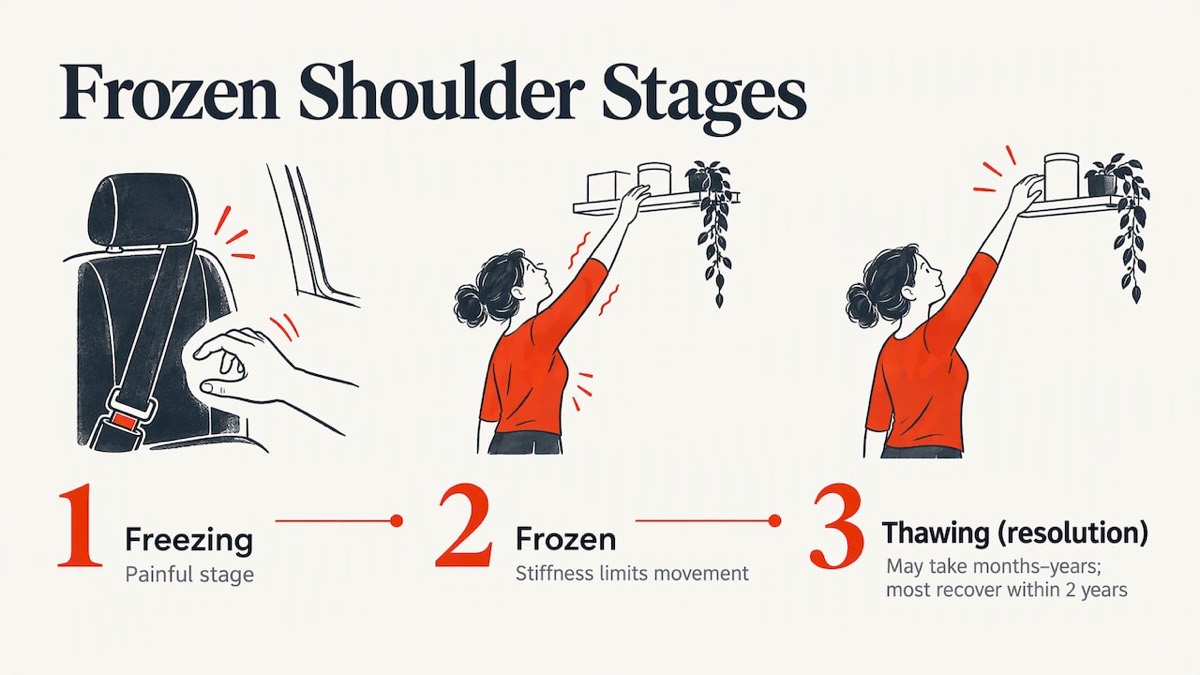
This stage is often the most encouraging, but it can also be the one where people drift away from their exercises. Range tends to come back in small steps: first you notice you can reach the seatbelt more easily, then the back pocket, then the top shelf. Continuing with regular, gentle movement and rebuilding strength around the shoulder makes sense while the joint is opening up.

Why a frozen shoulder hurts more at night
Night pain is one of the main reasons people search for help. NICE notes that pain can be worse in bed, and South Tees says it is commonly aggravated by lying on the affected side. Lying on the sore shoulder compresses it, and lying on the other side can let the sore arm drop forward and pull on the joint.
Practical changes that fit the guidance:
- Support the arm. NICE advises using pillows to support the arm and to stop you rolling onto the affected shoulder. A pillow tucked against your chest to rest the forearm on works well for many people.
- Try heat before bed. NICE says hot packs may help. Use a warm, not scalding, pack with a cloth between it and your skin.
- Take pain relief as advised. NICE says analgesia should be taken as directed. Ask your pharmacist or GP what is suitable for you, particularly if you take other medicines.
- Rethink your sleeping position. Lying on your back with the arm supported, or half-propped on a couple of pillows, takes pressure off the joint. Our article on side sleeping and shoulder pain has pillow changes to try tonight.
If you are regularly losing sleep, do not just put up with it. The Midlands Partnership NHS Foundation Trust lists regular sleep disruption among the reasons to seek medical review of a painful shoulder.
What helps at each stage
NICE’s central message is that care follows symptoms: control pain and keep tolerable movement early, then work on stiffness as the pain settles, rather than following one fixed routine throughout.
During the painful stage
- Pain relief and heat, as above.
- Gentle movement within comfort, such as letting the arm swing like a pendulum while you lean forward.
- Avoiding the movements that provoke the worst pain, while continuing to use the arm for light daily tasks.
During the stiff stage
- Regular stretching and mobility exercises, little and often.
- Hands-on treatment and supervised exercise. South Tees lists manual shoulder mobilisation, spinal or scapulothoracic manual therapy, home exercise, supervised exercise, hydrotherapy, posture advice and education among the options.
- Attention to the neck and upper back, which often tighten alongside the shoulder.
During the thawing stage
- Progressing exercises as range returns.
- Rebuilding strength and control so the shoulder copes with normal activity again.
Across the stages, the NHS describes a stepped approach: pain relief first, stronger pain relief or a steroid injection when needed, then gentle home exercises and physiotherapy to restore movement. NICE suggests considering physiotherapy early, usually for 6 weeks, with a further 6 weeks if symptoms or function improve. The physiotherapy NICE describes can include education, exercises, manual therapy, heat and electrotherapy.
On manual therapy specifically, a Cochrane review of manual therapy plus exercise found no clinically important difference in pain and function at 6 and 12 months when compared with injection, and noted that evidence for several combinations of treatment is still developing. In practice that supports what clinicians already do: use hands-on care as one part of a plan alongside exercise and education. Some people also explore options such as acupuncture for shoulder pain while they decide how to manage symptoms. Whatever you choose, keep a clear picture of how your function is changing so you can judge what is helping.
What to avoid with a frozen shoulder
- Forcing the movement through pain. East Lancashire Hospitals NHS Trust advises against pushing through pain because it can worsen the pain and prolong the condition. It recommends comfortable heat, pain relief and exercises suited to the stage you are in. Their patient leaflet sets this out.
- Resting the arm completely. NICE advises avoiding movements that worsen pain while continuing to use the arm to maintain movement. Both halves matter.
- Sleeping on the sore side. Especially in the first stage.
- Aggressive stretching early on. Stretching intensity should match the stage: gentle when it is painful, firmer only as pain allows.
- Waiting indefinitely. The condition tends to improve on its own, but that does not mean you must simply endure it.
Frozen shoulder or rotator cuff problem?
The two are easily confused because both cause shoulder pain, including at night. The clearest difference is passive movement. In frozen shoulder, the joint is stiff both when you move it and when someone else moves it, particularly in outward rotation. With many cuff problems, the pain and weakness show up when you lift or rotate actively, but a helper can often move the arm further than you can. Only a hands-on examination can tell them apart reliably, which is one reason assessment matters before you commit to a stretching routine.
When to get your shoulder assessed
NICE advises secondary-care referral if pain or stiffness has lasted up to 3 months without benefit from conservative measures, or earlier where symptoms are severe, quality of life is badly affected or the diagnosis is uncertain. The BESS/BOA pathway stresses shared decisions based on how restricted you are, how severe the problem is and how you respond to care, not on duration alone.
The Midlands Partnership NHS Foundation Trust advises medical review for:
- a deformed-looking shoulder, or a recent injury or surgery
- regular sleep disruption
- fever or feeling generally unwell, or unexplained weight loss
- numbness or weakness
- rapidly worsening pain
- pain that has not improved after a couple of weeks of self-help
BESS/BOA also lists urgent red flags: a suspected infected joint, an unreduced dislocation, suspected malignancy, an acute traumatic cuff tear and suspected inflammatory arthritis. Any of these means seeing a GP, NHS 111 or urgent care promptly rather than booking a routine appointment. If shoulder or shoulder blade pain comes with chest pain, breathlessness or sweating, call 999. Our guide to shoulder blade pain red flags explains this in more detail.
Our perspective on frozen shoulder
Most people who walk into our clinic with a frozen shoulder have already spent weeks being told it will “just thaw”. That may be true in time, but nobody should have to spend months not sleeping while they wait.
At Elaris we start by working out what stage the shoulder is in and what else is going on around it. The shoulder rarely suffers alone: the neck, upper back and shoulder blade are usually involved. Our Elaris Method™ looks at structural, neurological and emotional factors, because poor sleep, worry and a stiff neck all feed the pain.
What we do differs by stage. Early on, the aim is to settle things and protect your sleep. Later, as the shoulder stiffens, we add more movement and hands-on work. You see the same two practitioners at every visit, you get a written plan, and we measure your progress as we go so you can see the shoulder changing.
If your history or examination suggests something that needs a GP or hospital specialist, we tell you plainly and point you there.
— Dr Stephen Davison (Doctor of Chiropractic)
How we help at Elaris Chiropractic
We are a chiropractic and wellbeing centre in Great Totham, Essex, run by Stephen and Jo Davison, who have over 25 years of experience. We see patients from Maldon, Tiptree and the surrounding villages with neck and shoulder pain and related problems. Frozen shoulder needs a proper diagnosis, and the evidence for chiropractic treating it is limited, so we will explain what we find and refer you to your GP or a physiotherapist where that is the right route.
Your first consultation and examination costs £105. It includes a hands-on examination and neurological testing, and we explain what we find and set out a written treatment plan. Our neck and shoulder pain page describes how we approach these problems.
If your shoulder is keeping you awake or you cannot reach behind your back, you can book your first consultation and examination with us.
FAQ
What is the fastest way to heal a frozen shoulder?
There is no quick fix, because the condition follows its own course over many months. What you can do is keep pain under control, keep the arm gently moving and match your exercises to your stage. NHS guidance describes stepped care, from pain relief through to steroid injection and physiotherapy when needed. A proper assessment helps you choose the right steps for your shoulder.
Should a frozen shoulder hurt all the time?
Not usually. In the first stage, pain can be constant and worse at night. In the stiff stage, the constant pain generally eases and you notice stiffness and sharp twinges at the limit of movement instead. If pain is rapidly worsening or not improving after a couple of weeks of self-help, get it checked.
How long does each phase of frozen shoulder last?
Typical ranges are 2 to 9 months for the painful phase, 4 to 12 months for the stiff phase and 12 to 42 months for resolution. The phases overlap, and individual people can be quicker or slower. Most people recover normal function and movement within about two years without treatment.
Can chiropractic help a frozen shoulder?
Hands-on care, including manual therapy of the shoulder and the spine around it, is one of the options listed in NHS physiotherapy guidance alongside exercise and education. We do not claim to treat frozen shoulder itself. At Elaris we can assess your shoulder, neck and upper back, explain what we find and, where appropriate, refer you on.
Sources
- Frozen shoulder, NHS
- Frozen shoulder (adhesive capsulitis), NHS Gloucestershire clinical guidance
- Physiotherapist booklet: frozen shoulder, South Tees NHS
- Adhesive capsulitis, NHS Tayside Right Decisions
- Frozen shoulder, Sussex Community NHS
- Frozen shoulder, NICE Clinical Knowledge Summaries
- BESS/BOA patient care pathway for frozen shoulder
- Manual therapy and exercise for adhesive capsulitis, Cochrane Library
- Frozen (contracted) shoulder, East Lancashire Hospitals NHS Trust
- Frozen shoulder, Midlands Partnership NHS Foundation Trust